
Jump directly to the page contents

from Charlotte Holzer

A museum airplane telling its story is an exciting experience to witness as a conservator. During the dismantling of the Fokker D.VII for transport back to the Netherlands, the aircraft revealed a much more nuanced identity than being an item of war. Once again, this experience highlights why respecting an object history and learning how to read the hidden traces is so important.

Back to the roots of the Marine Luchtvaartdienst Fokker D.VII

Much has been written about the implications of the German occupation of the Netherlands during World War II on the Deutsches Museum’s Fokker D.VII. However, the origin of this extremely rare original airplane goes way beyond and has its roots in the military aircraft production of the First World War. This type of fighter aircraft, with its characteristic welded fuselage framework, first came into action in 1917 and was manufactured in large series at the “Fokkerwerke” in Schwerin. Licence products made by the competing “Albatroswerke” had a wooden framework.

By the end of the war, the industrialist Anthony Fokker re-purchased the commissioned airplanes from the “Deutsche Fliegertruppe” and organized the transfer of his company to Amsterdam in cooperation with the German authorities. In 1919, the newly founded “N.V. Nederlandsche Vliegtuigfabriek” already delivered the first Fokker D.VII to the “Marine Luchtvaartdienst”, stationed in De Kooy. It is still up to debate in research groups, whether the Fokker D.VII in the custody of the Deutsches Museum was made entirely from scratch in the Netherlands or from German parts produced in Schwerin. 

Over the next 18 years, the aircraft were in service in the Netherlands and overseas, with regular maintenance works and technical updates done to keep airworthiness. Pilots used whatever machine was ready that day and switched between aircraft types, such as the Fokker D.VII or the later Fokker C V. The phase of active operation of the original D-series ended on July 29th 1937, with the last aircraft to be withdrawn from use. 

Change of location - change of story telling

The next 20 years of object history is one about storage and transport. The machine with the marking D-28 came in storage of the Koninklijke Luchtmacht to be displayed in a national aviation museum. The whereabouts of the other airplanes range from destruction to storage, e.g. for using spare parts. The knowns and un-knowns of the airplane’s dislocation in the period between the German occupation of the Netherlands in May 1940 and the accession to the Deutsches Museum in 1948 are detailed in the Blog “Eine Fokker D.VII für Hermann Göring”. 

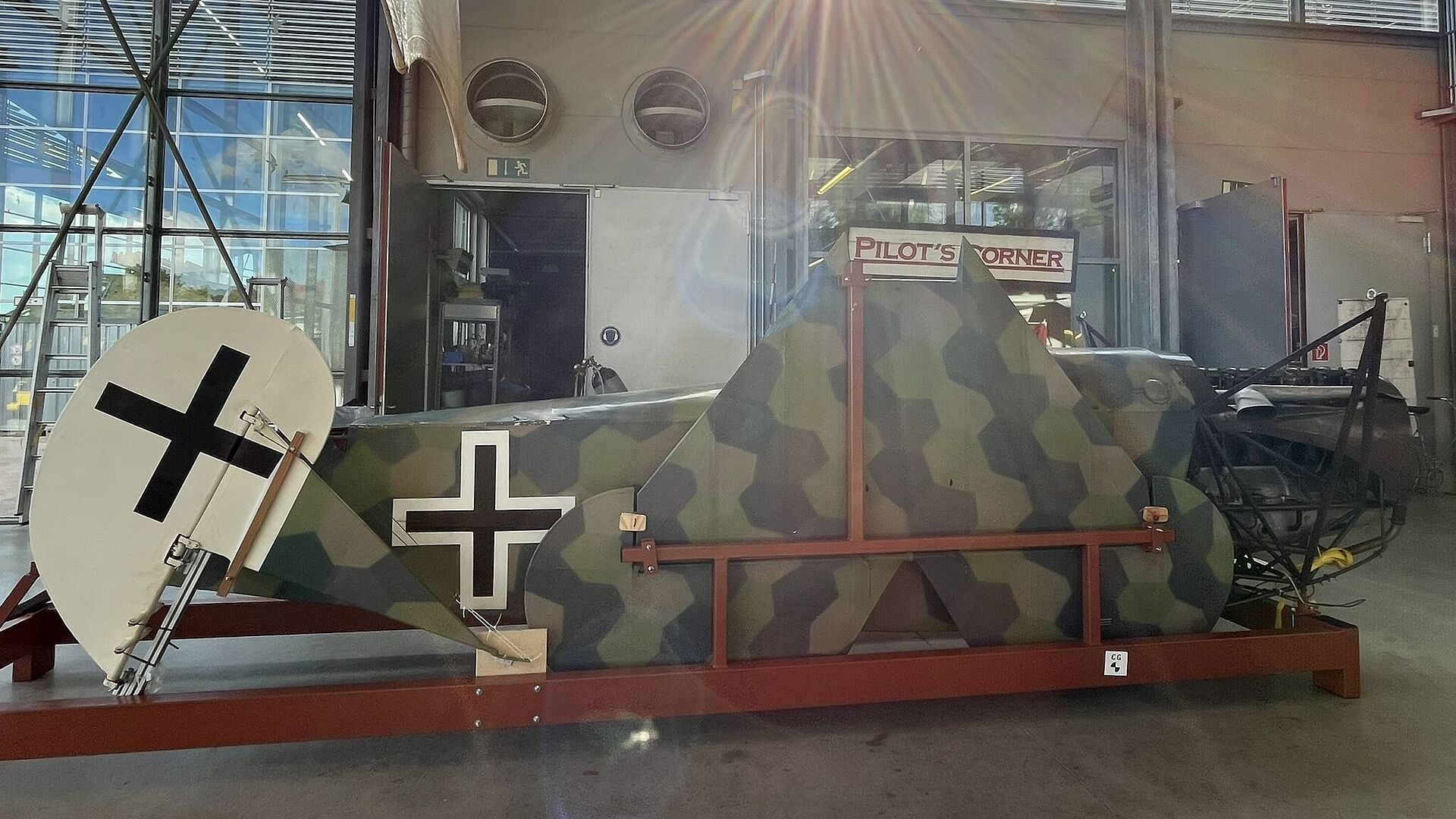
The preliminary ending of this journey was in November 1956 the interim aviation workshop of the Deutsches Museum in Munich. The Fokker D.VII entered the collection in a disfigured state, with a historizing Camouflage paint and a World War I Mercedes inline IIIa that suggested a German origin to the untrained eye. The structural and surface changes date to 1940-1942.

From 1957 onwards, the airplane served as an exhibition piece in the old aviation hall (“Alte Luftfahrthalle”), giving visitors direct access to the technology of the early days of aerial warfare. From 1977 onwards a new generation of curators, that no longer had any connections with the “Reichsluftfahrtministerium” of the Third Reich started their work. They familiarized themselves with the collection, compiled object histories, including the Fokker D.VII and unveiled research questions independently of the old advisory board. The identity as a Dutch airplane from the original D series was common knowledge in aviation research groups and in the Deutsches Museum since 1980. 

The old ways of caring for museum aircrafts

In the years leading to the opening of the new aviation hall (“Neue Luftfahrthalle”) in 1984, in-depth historical research moved to the background and the well-trodden tracks of collection care kicked in. The standard operational procedures at the time was to paint old, “shabby-looking” airplanes, which also did not spare the Fokker D.VII. In early 1980, the lower wing and tail unit were dismantled and spray-painted with thick layers of non-aviation-grade materials. The fuselage, upper wing and landing gear received treatment in-situ in the exhibition working mainly with brushes. In the engine section, in the cockpit and on the top of the upper wing minor retouching of damaged areas happened. 

Today, traces of this traditional restoration approach are especially apparent under ultraviolet (UV) radiation: fluorescence of the differently applied varnish and drops from the painting brushes on the object, residues of the 1920s and the 1940s paint layers appearing in formerly covered sections or residues of smeary rubber care products on the wheels.

New researchers and new methodologies

After the opening of the new aviation gallery in 1984, the Fokker D.VII was left in its natural ageing process until July 2001: within three days, the aviation workshop dismantled the airplane, guided the transport and put it back on display at the branch museum “Flugwerft Schleißheim” which was opened in 1992. On the one hand, the deterioration of the more than 80 years old Fokker D.VII accelerated considerably under the harsher light and climate conditions in the “Alte Werfthalle”. On the other hand, the arrival of the next museum staff generation revived the research interest into the airplane, that lead to a loan agreement with the Nationaal Militair Museum in Soesterberg. The objectives of these studies focused on building a Fokker D.VII replica, developing a scientific methodology for paint on airplanes and provenance research on the period between 1941 and 1948.

Getting to know the airplane

When the time came to prepare the Fokker D.VII for the journey to the Nationaal Militair Museum in Soesterberg in summer 2025, the knowledge base had grown exponentially in the separate research fields. In order to develop safe handling and transport instructions for the installation in the Dutch military exhibition, I had to create my own holistic survey. In the aviation workshop, I could study the dismantled airplane, do cross-referencing to the prior studies, rely on the fundus of the museum library and use simple, non-destructive analysis for further insights (light microscopy, UV radiation). 

As a conservator trained in scientific object studies, I put my emphasise on the sensitivity of the original and added materials as well as the state of condition of the airplane. Having learned from my experienced colleagues in the aviation workshop for some years now, I started out with my general understanding of historic aircrafts and then worked my way into the manufacturing techniques of the Fokker airplanes and the treatment procedures of the old Deutsches Museum workshops. The result was a list of material aspects to consider, with heightened awareness of the fragility of the paint layers.

Conservation survey of the Fokker D.VII

During the risk assessment phase, it was essential to become mindful of the airplane’s age: In September 2025 we were off to transporting a 107 years old Fokker D.VII, that was used for 18 years, had a rough mobility history of 20 years and was on display under less than ideal conditions at the Deutsches Museum for 68 years. 

The welded steel structure of the fuselage originated from 1918/1919, repaired after an accident on the left rear side and went through two changes of the engine mountings in the front section. The last maintenance of the wooden wing structure was during active service on 25th April 1932, according to a date written on the spar of the upper wing. All the maintenance tags typically put in round patches on the Dutch Fokker airplanes were removed on the Deutsches Museum Fokker D.VII.

The pressure sensitive cover with fabric is about 100 years old. Apart from the left elevator and the right side of the fuselage, the textile shows a similar weave density and thread twist as a comparable World War I Fokker fabric, associated to the DR I of Manfred von Richthofen (Deutsches Museum Collection, Inv. No. 79897). In general, the fabric shows several repairs with patches and is generally degraded from mechanical impact, paint stripping, climate fluctuation, light and pollution. There are holes around the wing tips from handling and a large tear in the lower right wing cover, caused by deformation of the lower wing leading edge. 

The aluminum and replica steel sheets are deformed from repeated dismantling and assembling. In cooperation with Mathias Winkler from the aviation workshop two groups of metal sheets were distinguished: those connected to their original sub-structure on fixed attachment points and those attached to moveable mounts on the frame, that also have some new or enlarged holes to make them fit. Group one includes the top cover of the fuselage with marking tags of the D28 from 1933/34. In the second group are the wheel covers taken from the aircrafts S8, S11, S16, 30 and S75 of the Marine Luchtvaartsdienst and the engine cowling in 1941/42 (tags “800” or “008).

Further mechanical damage includes the broken mounting structure of the skid, crumbling leather parts in the cockpit and fuselage and worn-out rubber shock absorbers of the landing gear. The sticky rubber lubricant on the tires as well as darkened and aged fats on the axis of the landing gear calls for a hand wash before handling anything else.

For the paint layers, three main considerations have to be taken into account: The camouflage and Deutsches Museum painting were not applied in the traditional aviation layer built-up and therefore are more prone to mechanical damage from movements and vibration. A network of fine cracks is already covering the outer surface of the airplane. On the metal sheets of the fuselage top, engine section and wheel covers the lacquer is delaminating, especially around the attachment points. Overall, there is a sensitivity of the paint layers to abrasion.

Crossing borders - joint effort for a safe journey to the Netherlands

The safe transport of the Fokker D.VII to Soesterberg and the gallery installation became possible by providing an ideal framework of cooperation between the museums. Based on their decades of experience Peter Hanickel, Helmut Hanickel, Reinhard Mücke, Hermann Drexler and Mathias Winkler built transport crates to mount the airplane on its structurally sound points, meeting all my conservation requirements. Thanks to the generosity of the Nationaal Militair Museum, the whole workshop team travelled to the Netherlands and was supported on site by freelance specialists Martin IJdo (Historic Engineering) and Cees Van De Wetering (Historic Military Services).  

The workshop group had sufficient time to carry out the exchange of the Nationaal Militair Museum Fokker D.VII (No. 266) with the Deutsches Museum airplane in the gallery. We learned more background information about the service period of the airplanes in the Netherlands at the Fokker archives of the Aviodrome in Lelystad, went through the condition survey with the local staff and did the risk assessment for the exhibition. At the end of the week, the researchers Dennis Mitschke and Andreas Hempfer joined the museum director Frankwin van Beers, curator Alfred Staarman and others to present our latest findings about the Fokker D.VII.  

As usual, the in-depth investigation of the original object brought even more research questions to light. From the perspective of the conservator the two main research routes to follow up are the manufacturing / maintenance techniques found on the Fokker D.VII and the ageing process of the historic materials. The main preservation challenges for this aircraft are the stabilizing of the fabric in general and paint layers on textile, wood and metal. Possible structural issues of failing glues in the wooden structure were not identified so far, but need to be monitored.

As outlined in this blog, I as a conservator prefer a holistic approach to investigating an object biography, in order to understand the specific airplane and make well-founded treatment / handling decisions. Future research topics include the story of the Mercedes IIIa engine (No. 45266) and cowling, a comparison of Fokker airplanes made in Schwerin and Amsterdam, flight operation and repair at De Kooy airfield in the 1920s-1930s, a characterization of the Camouflage paint layers from 1940/41 and aircraft restoration at the Deutsches Museum. 

The international expert team provides the possibility to connect the object studies with archival research and practical experience from aircraft manufacturing and operation. Starting in September 2025 the Fokker D.VII is on loan in Soesterberg for five years. This situation opens up new in-situ research possibilities in the Netherlands, where the manufacturing and service of the aircraft took place.

Further Reading

Nico Geldhof: De Fokker D.VII. In dienst van de Nederlandse militaire luchtvaart, Nieuwegein 2008.

Peter M. Grosz, Volker Koos: Typenbücher Deutsche Luftfahrt. Fokker Flugzeugwerke in Deutschland 1912-1921, Königswinter 2004.

Paul Leamann:  Fokker Dr.I Triplane: A World War One Legend, Hersham 2003.

Otto Mayr: Der Wiederaufbau 1945-1969, in: Wilhelm Füßl, Helmuth Trischler (Hrsg.): Geschichte des Deutsches Museums. Akteure, Artefakte, Ausstellungen, München 2003.

Dennis Mitschke: Deutsch oder „Dutch“? – Untersuchungen an der textilen Bespannung und dem Anstrich der Fokker D.VII aus dem Deutschen Museum, München, unpubl. Masterthesis, ABK Stuttgart, Stuttgart 2020. 

A.R. Weyl: Fokker: The Creative Years, New York 1987.

Bernhard Wörrle: Eine Fokker D.VII für Hermann Göring, Deutsches Museum Blog, https://blog.deutsches-museum.de/2025/03/20/eine-fokker-dvii-fuer-hermann-goering, 20.3.2025.

Author

Charlotte Holzer

Dr.

Charlotte Holzer holds a PhD in textile conservation and has been working with the curators of aviation, space travel and shipping on the new permanent exhibitions since 2019. Her current research focuses on the conservation of technical textiles, such as aircraft fabrics and protective suits.

Her tip for a visit to the Deutsches Museum is to pop into the Flugwerft Schleißheim. In a relaxed, friendly atmosphere, the museum staff share their boundless enthusiasm for the valuable exhibits with visitors