

Jump directly to the page contents

from Dominik Roth

From analogue Link Trainers to digital cockpits, simulators have shaped pilot training and flight safety. Over time, the growing importance of flight simulators has been one of the most striking developments in the training of commercial pilots. But how did this evolution unfold, and what technological advances accompanied it? Historical artifacts at the Deutsches Museum make answers to these questions tangible.

This content was machine-translated with DeepL, but thoroughly checked. Still, please let us know if you spot anything odd!

In the “Modern Aviation” exhibition, visitors encounter two different flight training devices. One of these is a Link Trainer dating from 1944 – named after its inventor, Edwin Link (1904–1981). Link adapted mechanical and pneumatic components from organ building to develop a device that could rotate along all three axes of space, thereby simulating the movements of an aeroplane. The Link Trainer’s model cockpit also featured all the key analogue instruments a pilot needed for navigation during night or blind flights: an artificial horizon, an airspeed indicator and an altimeter, as well as a radio compass and a course deviation indicator.

The contrast with the second device on display at the Deutsches Museum – a flight simulator for the Diamond DA42 NG, a twin-engine propeller aircraft seating four people – is striking. Its cockpit model – equipped largely with digital instruments – is surrounded by a screen onto which a computer-generated landscape is projected. Several digital computers ensure that the Diamond’s flight characteristics are reproduced realistically. Here, a flight instructor also has the option to alter the weather conditions in the virtual environment and to incorporate technical failures of the aircraft into the simulation.

However different the Link Trainer and the Diamond Simulator may seem, they essentially serve the same purpose: to enable pilots to learn how to fly and handle an aeroplane. However, there is a 70-year age gap between the devices, as well as a host of technical differences. This raises two questions: What developmental steps actually lay between these seemingly completely different technologies? And how did the practice of “learning to fly” change alongside the devices?

Electronic flight simulators of the 1940s and 1950s

Whilst thousands of pilots were still being taught essential flying skills on the Link Trainer during the Second World War, efforts were already under way to develop a new generation of flight simulators. In 1941, Richard Carl Dehmel (1904–1992) filed a patent application in the United States for a “device for flight training”, which was granted to him in 1950. According to Dehmel’s ideas, his invention was intended to fulfill two purposes: Firstly, it was intended to familiarise flight students with an aircraft’s response to their control inputs. Secondly, it was designed to train them to fly purely by instruments using ground-based radio infrastructure for navigation when external visibility was lacking.

Dehmel’s invention was designed to simulate all the radio navigation signals that a pilot of the time would receive during an actual flight: the signals from a radio beacon, the glide path and the approach signals of an instrument landing system, as well as the signals from an “A-N radio range”, which were received in the cockpit via headphones as audible Morse code signals for “A” and “N”. (If “A” and “N” overlapped to form a continuous tone, the pilot was on a predefined heading.) Another distinctive feature of this new generation of flight simulators was that the devices were now based on analogue computers, which calculated the state of the simulated aircraft in the air in real time.

In 1943, several years before his aforementioned patent was granted, the US aircraft manufacturer Curtiss-Wright hired Richard Dehmel and launched the first electronic simulator in 1946. After the Second World War, a duopoly developed between Curtiss-Wright and Edwin Link’s company, which was now also offering computer-based simulators. Curtiss-Wright sold the first electronic flight simulator for civilian use to Pan American World Airways. Link was awarded the contract by the US military to build the first simulator for a jet-powered aircraft with its “C-11” model series. A C-11 that was once used by the German Air Force is now also part of the Deutsches Museum’s collection. This new generation of electronic simulators quickly became established, despite their complexity and the notorious unreliability of the vacuum tubes used in them. Furthermore, the purchase of a fully-fledged electronic simulator involved enormous costs; prices were in the six-figure dollar range.

However, several advantages of the new devices stood out in comparison to flying in a real aircraft: training sessions in the simulator were significantly cheaper and could take place regardless of the weather and other air traffic. Furthermore, technical faults and emergency situations could be practiced safely on the ground, without risking a potentially fatal crash. In 1949, Pan American forwarded an internal study to Curtiss-Wright with words of appreciation: thanks to their simulator, safety standards in pilot training were higher, costs were lower and the duration of training was shorter than ever before.

The "Dehmel Flight Duplicator" at the Deutsches Museum

Alongside the expensive simulators, Curtiss-Wright also manufactured a more affordable product range, the ‘Dehmel Flight Duplicator’. Whilst the simulators elaborately replicated a specific type of aircraft, including its flight characteristics and cockpit instrumentation, the Flight Duplicator was primarily a training device for radio-based navigation procedures. One such device has been part of the Deutsches Museum’s collection since 2021. As very little documentation on these objects has survived and only a few other devices are held in the collections of other museums in the USA, it is all the more revealing to examine the museum’s own Flight Duplicator at close quarters in the depot.

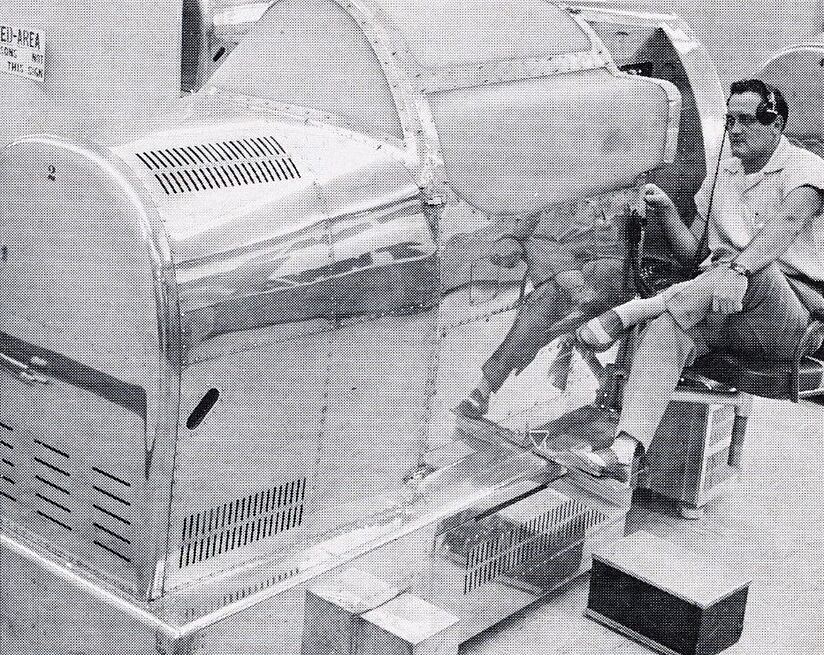
The object is stored there in five separate parts: the rear section of the cockpit with the student pilot’s seat, the front section with the instrument panel, a fairing, a control panel for the instructor, and the central control unit. The student pilot’s seat is surrounded by the main controls: centrally in front of the seat are the control wheel and foot pedals for moving the virtual aircraft’s control surfaces; on the left-hand side are the levers for engine power, the landing gear and the landing flaps. The pilot’s headphones are also hung here in a designated holder. A key component of this training device is mounted centrally above the pilot’s seat: just as in a real flight, the control unit for the automatic direction finder (ADF) was used to manage the reception of radio navigation aids or weather reports transmitted by radio.

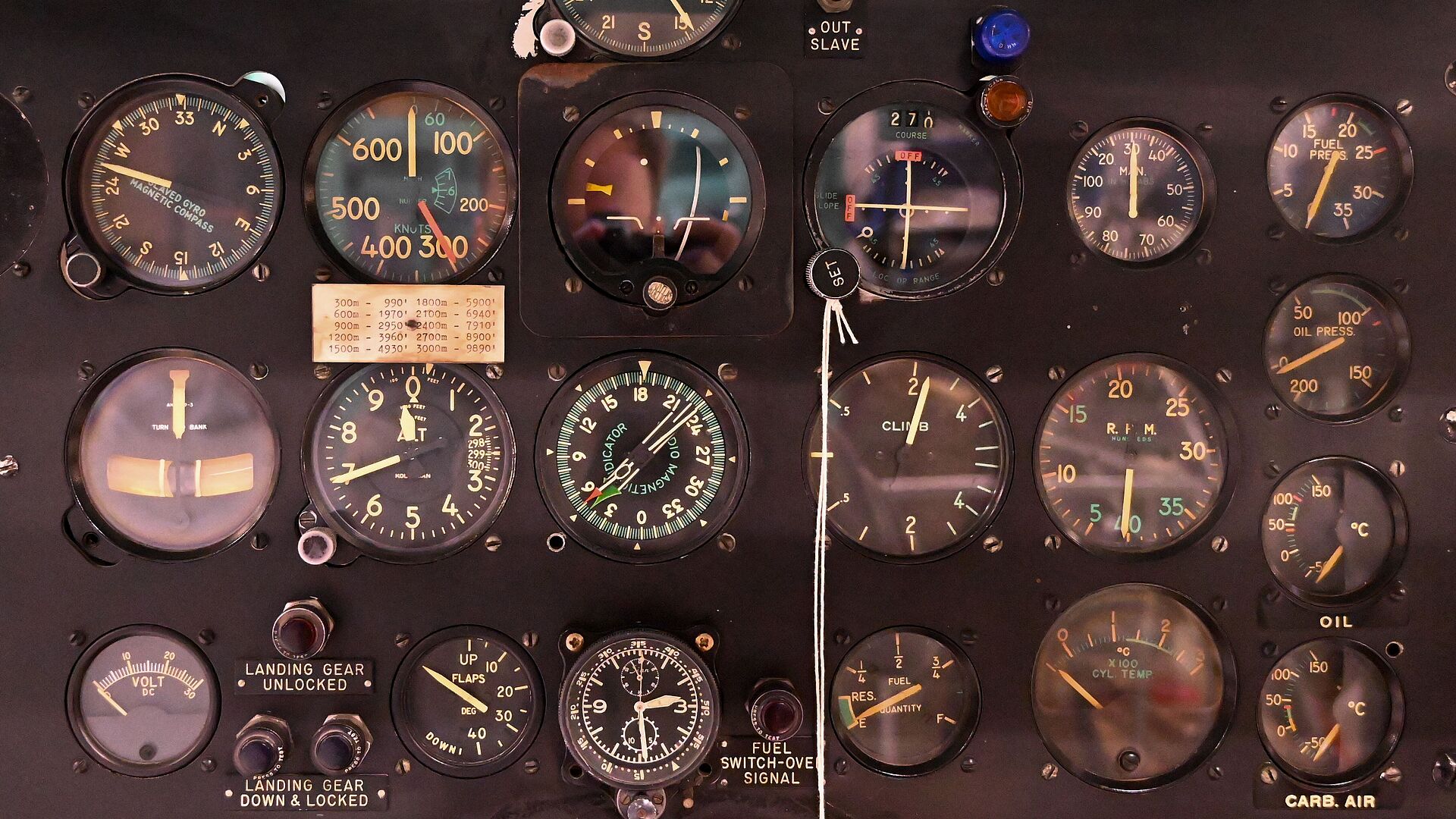
One thing is clear: training in the Flight Duplicator was carried out solo. The trainee pilot sat alone in the cramped cockpit, rather than, as in a larger simulator, alongside another pilot and a flight engineer in a large model cockpit. As a training device,the Flight Duplicator thus fulfilled a specific purpose: the aim here was not to learn the particular characteristics of a specific aircraft type in which several crew members worked together, but rather to practice, on an individual basis, the customary navigation procedures of the time. This is also reflected in the layout of the instrument panel: alongside the basic instruments such as the altimeter, airspeed indicator and artificial horizon, the focus here is on the most important navigation instruments. These include, in addition to the radio compass, two different course gyros and a course deviation indicator.

The instructor, who led the training session in the Flight Duplicator, was seated on the left-hand side of the cockpit. At the heart of his workstation was the “Dehmel Automatic Radio Aids Unit”, featuring a control panel where the instructor set the key parameters for the exercise in question. These included weather conditions such as wind direction, wind speed and temperature; for training in instrument landing procedures, the altitude and direction of the simulated runway as well as the glide path and the approach markers for the final approach were configured. The parameters for the simulated “A-N radio range” were also set here.

The instructor’s station also had another key function: the flight path completed by the trainee was automatically plotted onto a chart disc using a pen. This allowed the instructor to monitor in real time whether the trainee was on the prescribed course; furthermore, he could subsequently discuss the trainee’s ‘navigation performance’ with them using this record. One such chart disc is still clamped into the Automatic Radio Aids Unit in the museum’s depot. This reveals a direct link to the Flight Duplicator’s former place of operation: in the typical style of an aeronautical chart, important landmarks around Hamburg Airport are marked on it. These include, for example, the two runways 05/23 and 15/33, the final approach to runway 23 on a heading of 232°, and the corresponding outer approach marker directly in the center of the circular chart.

"Flight Duplicator", electronic flight simulators and the nature of modern aviation

The object of the Deutsches Museum was previously used by Lufthansa to train its own pilots. Lufthansa purchased this Flight Duplicator in 1957 for $150,000 from Curtiss-Wright and put it into operation in the newly completed ‘simulator building’ at Hamburg Airport. It was not the only piece of equipment housed there. Between 1957 and 1958, several electronic simulators were added: a simulator for the Lockheed L 1049-G Super Constellation and one for the Boeing 707, both from Curtiss-Wright, as well as a simulator for the Vickers Viscount from the British company Redifon.

In the absence of precise records regarding the use of the Flight Duplicator and the other simulators mentioned at Lufthansa, it is worth comparing the situation with that of other airlines. The US-based Trans World Airlines also brought together simulators and procedural trainers in a single training center. The two types of equipment were intended to complement one another through their respective areas of application. An advertising brochure explained that, across a total of five simulators, crews practiced the airline’s standardized procedures as a team. Much of the training was devoted to emergency procedures, whether in the event of a fire, engine failure or other technical malfunctions. Four Flight Duplicators, on the other hand, were designed to enable precise training in radio navigation procedures.

It is remarkable how quickly international airlines integrated this new generation of simulators and training equipment into the training of their own pilots. Lufthansa, newly founded in 1953, began training its own pilots from scratch in 1955, and by 1957 it was already operating a dedicated simulator building. The proportion of simulator hours in commercial pilot training increased even further in the years that followed. In 1979, a conference of the simulator industry in London noted that simulators had by then been developed for 80 different aircraft models. In 1981, in the USA, retraining for a new aircraft type was permitted to take place entirely in a simulator for the first time; a check ride in a real aircraft was no longer required.

During this period, simulators and procedural trainers such as the Dehmel Flight Duplicators not only helped shape pilot training practices but also had an impact on the safety culture in civil aviation and on the pilot’s role itself. The increasing complexity of modern aircraft technology and the growing density of air traffic made adherence to standardized, internalized procedures at the cockpit workstation all the more relevant. Repeated practice in simulators and procedural trainers as well as the attempt to train pilots to react confidently in real flight operations by exposing them to every conceivable malfunction scenario, was intended to contribute to the reliability of flying.

A step on the path towards today’s flight simulator

However, Curtiss-Wright’s Flight Duplicators had already become obsolete by the mid-1960s. From 1964 onwards, Lufthansa no longer used its equipment for training, but only for the selection process for new pilot candidates. By then, new radio navigation procedures had become established, for which the 1957 model was no longer designed. Even with this generation of electronic flight simulators and procedure trainers, however, the value of simulator-based training had already become evident in aviation. The underlying technology, meanwhile, underwent continuous development and, over the coming decades, increasingly took on the form of today’s fully-fledged flight simulators.

Digital computers gradually replaced analogue technology. Simulating the movements of an aircraft once again became a fundamental component of the equipment – but now implemented via hydraulic systems rather than pneumatically, as was still the case with the Link Trainer. Advances in computer-generated imagery then made it possible to integrate increasingly sophisticated visualisations of the outside world into the simulator. In the the “Modern Aviation” exhibition at the Deutsches Museum, the simulator for the Diamond DA42 NG, with its photorealistic rendering of the surroundings, demonstrates the current state of this technology.

Author

Dominik Roth

Dominik Roth is a historian and was a Scholar-in-Residence at the Deutsches Museum’s Research Institute from March to July 2026. During his time there, he worked on a research project examining changes in the civilian aircraft cockpit and pilot training during the second half of the 20th century.

His tip for a visit to the Deutsches Museum: a trip to the Flugwerft Schleißheim is a must for anyone with an interest in aeronautical engineering. On the Museumsinsel, you should also be sure to visit the special exhibition ‘Planetary Health’, which runs until the end of September 2026. The exhibition does not stop at a pessimistic outlook in the face of climate change and environmental degradation, but also highlights people and solutions that are making the coexistence of humans and nature more sustainable.

Dominik Roth

Dominik Roth is a historian and was a Scholar-in-Residence at the Deutsches Museum’s Research Institute from March to July 2026. During his time there, he worked on a research project examining changes in the civilian aircraft cockpit and pilot training during the second half of the 20th century.

His tip for a visit to the Deutsches Museum: a trip to the Flugwerft Schleißheim is a must for anyone with an interest in aeronautical engineering. On the Museumsinsel, you should also be sure to visit the special exhibition ‘Planetary Health’, which runs until the end of September 2026. The exhibition does not stop at a pessimistic outlook in the face of climate change and environmental degradation, but also highlights people and solutions that are making the coexistence of humans and nature more sustainable.