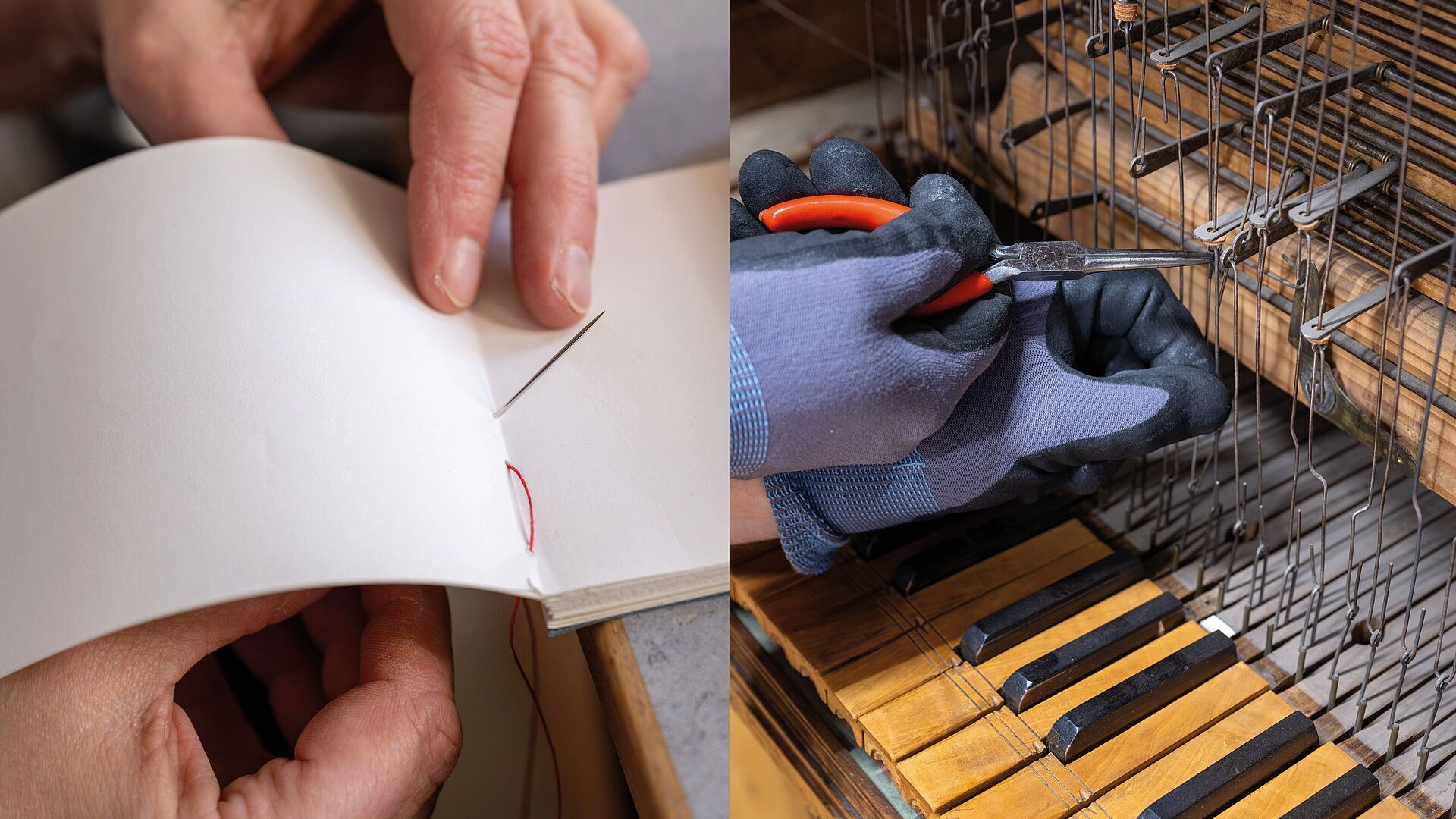
In the Deutsches Museum's in-house workshops, experts preserve ancient craftsmanship and techniques. Their expertise is indispensable for preserving technical cultural history for future generations. Beatrix Dargel visited a bookbinder and an organ builder. They are representative of the many craftsmen and women in the museum's workshops.
This content was machine-translated with DeepL. Let us know if you spot anything odd!
For over 25 years, Helga Grabendorfer has been ensuring that the books and publications of the Deutsches Museum are preserved. Photo: argum | Falk Heller
When a volume that has served generations of researchers is opened in the Deutsches Museum library, its good condition is often ensured by the work of Helga Grabendorfer. She has been a bookbinder at the museum for over 25 years - she is one of those invisible hands that ensure that knowledge remains legible for decades. All the books and magazines that - over the years - show signs of use end up in the binding room, a workroom with heavy cutting machines, pots of paste and piles of paper. "Bitte Binden - Please bind", for example, is written on the notes that arrive from the library. And the work never stops: the museum library's collection alone comprises around one million books, magazines and plans.
Sometimes a tear in the binding has to be mended, sometimes a page that has been cut out has to be replaced. "It should fit and be as unobtrusive as possible," says Grabendorfer as she handles a wafer-thin sheet of Japanese paper. The material weighs barely four grams and is applied with paste - a technique that has remained almost unchanged for centuries. Once the repair has dried, the paper melts invisibly into the original. If entire pages or illustrations are missing, the bookbinder uses other copies. The gap is closed with the right paper and a precise copy. "We want the books to be fully usable again without the intervention being immediately recognisable."
Helga Grabendorfer was a trained industrial bookbinder. She had been working shifts for 13 years when one day she read an advert for a job at the Deutsches Museum. She applied, was accepted and stayed. Today, she appreciates the variety of her work: "No two days are the same here." In addition to restoration work, she produces customised products such as archive cassettes, folders and customised slipcases to ensure that books, scripts and journals are stored in the best possible way.
Books that are frequently used in the reading room are reinforced with acid-free cardboard. This means they are stable on the shelf, won't fall over and are better protected from light and dust. Acid-free material is crucial: otherwise paper from the 19th century literally disintegrates in your hands. For journals that are not bound, the binding centre produces so-called “Streckmappen” - “stretch folders” - two sturdy cardboards connected by fabric straps in which the booklets are stored "stretched" upright. A simple but proven method of long-term archiving. "We think in centuries here," says Grabendorfer. "What we pack today should still be legible in a hundred years' time."
The bookbinder's work lies at the interface between traditional craftsmanship and modern restoration science. The paste - a mixture of water and wheat starch - is still cooked by the binder herself, but the choice of materials follows current conservation standards. Japanese paper, acid-free cardboard and age-resistant adhesives are procured according to precise specifications. Old coloured papers are also stored in shallow drawers: marbled, speckled and so-called “Kiebitzpapier”, i.e. clover marbled papers, whose pattern is reminiscent of the eggs of the bird of the same name. Many of these are hardly available today. "These are our treasures," says Grabendorfer, "some paper is no longer produced at all or only at horrendous prices."
Packaging is also part of the art of bookbinding. Books that leave the museum - for exhibitions, loans or mailing - are padded so carefully that even a fall will leave them unscathed. "We have to assume that a parcel will sometimes be thrown en route," says Grabendorfer dryly. "So we think ahead."
Whether she is mending a torn booklet, reinforcing a historical map or building a slipcase - Helga Grabendorfer always works with the same care. "You never stop learning," she says. "Every object is different, every material behaves differently." As quiet as her workshop in the Deutsches Museum may seem, what is at the heart of the museum's mission happens here every day: the preservation of knowledge. And sometimes all it takes is a sheet of wafer-thin paper.
Alexander Steinbeißer tuning an organ pipe. Photo: argum | Falk Heller
When Alexander Steinbeißer works on an old organ in his workshop at the Deutsches Museum, the room smells of wood, metal and history. With a steady hand, he opens an instrument that was on display in the music hall until 2016. "Organ building is practice, you can't study it," he says. "You need experience, an ear and patience - it can't be digitised."
There are over twenty organ instruments in the Deutsches Museum - from the small table organ to the large concert organ in the music hall. There are also mixed forms: Organ pianos, organ harmonies, technical experiments from past centuries. Only some of them are on display, the rest are in storage - a silent library of sound machines. It is unusual for a museum to house so many organs. Each one tells its own story. Some organs come from chapels, others from private music rooms. Hardly anything is known about some of them, while others still bear the name of their builder on a handwritten plaque. To find out more about his treasures, Steinbeißer first analyses typical building characteristics - the special signature of each organ builder. "Everyone has their own solutions, their own personal tricks," he explains.
The examination begins with dismantling. Each part is photographed, measured and catalogued. CAD drawings are created, material samples are analysed, X-ray and infrared images reveal hidden structures. Some instruments have been rebuilt several times, and it is only through these precise analyses that their development and origin can be reconstructed. Sometimes old papers inside - invoices, church register pages - tell of former workshops and locations. "In the past, nothing was thrown away," explains Steinbeißer, "the bellows were often lined with waste paper. Today, these are valuable traces for us." In the search for the original condition, old colour versions are sometimes uncovered in small, inconspicuous places. Each overpainting refers to a time when the organ was intended to match its surroundings - sometimes blue, sometimes brown, sometimes white like the nave. The results of such investigations are documented in detail. Nothing is changed in the current condition of the organs.
Steinbeißer has been responsible for the restoration of all of the museum's keyboard instruments since 2013: Organs, pianos, harpsichords, clavichords and self-playing music automatons. Maintenance, tuning, repair - everything is in his hands. His career began early: even as a schoolboy, he was fascinated by the special sound of the organ. At first, he simply wanted to play this impressive instrument. But he soon became even more fascinated by the mechanics than by playing the organ itself. In nearby Andechs, he was finally allowed to work with an organ builder - first tuning, later building. "It quickly became clear: that's what I wanted to do," he recalls.
"The organ is not an instrument, it's a system," explains Steinbeißer. "A huge machine consisting of wood, metal, leather and electrics. The interplay of all these materials creates the very special sound of each individual organ." Each organ contains the art of numerous trades: woodworking, metalworking, mechanics, voicing. No two organs are the same, none can be replaced. And this is precisely what makes organ building an irreplaceable craft to this day: each pipe is individually tuned to its sound, each stop has its own personality.
Machines can measure, but they don't hear like humans hear. They don't know when a sound is "alive". They lack access to emotions, which for us are always associated with musical experiences. In the Deutsches Museum, the instruments are not intended to sound new and perfect, but rather to be preserved first and foremost - along with the traces of their time. "Nothing is improved here, nothing is sold," says Steinbeißer. "We keep what was." In a world in which almost everything has become reproducible, organ building remains a alternative concept: precise, sensual, slow. And every time Steinbeißer makes a pipe sound, a piece of history resonates.